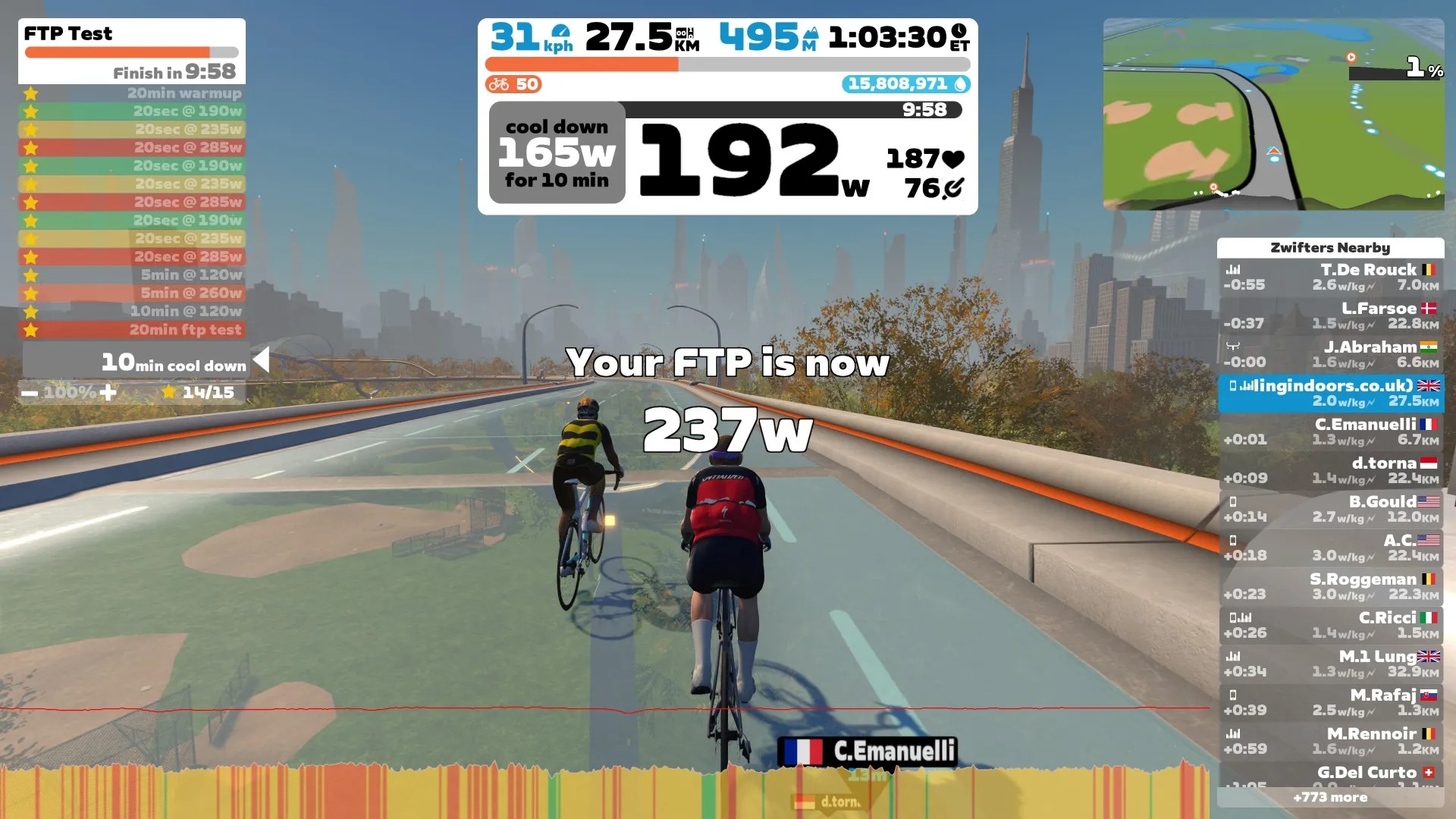
How can you measure your true ability on the bike?
FTP is more than just a number — it’s the key to understanding your performance and planning effective training for real improvement.
In this post, I’ll explain what FTP is, how it relates to lactate threshold, and how you can improve it efficiently.
What is FTP?
FTP — Functional Threshold Power (also referred to as L4) — is one of the most important metrics in cycling.
It represents the maximum power output (in watts) that a rider can sustain for one hour of steady, hard effort.
This number allows for accurate training plans and helps track progress over time.
What is Lactate Threshold?
The lactate threshold is the intensity level at which the body produces lactate faster than it can clear it.
At this point, lactate levels in the blood begin to rise, and the effort becomes harder to maintain for extended periods.
Physiologically, this is when the aerobic system can no longer meet energy demands on its own, and the anaerobic system takes over.
Once intensity exceeds this threshold, the time you can sustain the effort drops sharply, leading to muscle burning and increased fatigue.

How is Lactate Threshold Related to FTP?
FTP is defined as the average power a cyclist can hold for a full hour of steady effort.
It serves as a practical way to estimate your lactate threshold, because it reflects the exact point where you’re operating right at your physiological limit.
In practice, FTP is the watts-based expression of your lactate threshold.
It’s typically measured with a performance test — usually a 20-minute effort — from which your threshold power is calculated.
Example:
If a cyclist scores 280 watts in an FTP test, their lactate threshold is likely around that level.
FTP is an accessible and practical metric that allows for personalized training based on lactate threshold.
Why is Understanding This Connection Important?
- Accurate training planning: Knowing your threshold via FTP helps define precise training zones and improves performance without causing excessive fatigue or overtraining.
- Practical and accessible: Measuring lactate threshold usually requires lab testing and blood analysis, whereas FTP offers a simple alternative available to every rider.
- Performance gains: Improving your FTP increases your ability to work at higher intensities without quickly accumulating lactate.
Training Zones in Cycling and the Threshold

How to Improve FTP and Lactate Threshold
Improving your FTP requires a well-structured training program that includes three key elements:
- Endurance rides (Zone 2): Long, steady rides at a moderate pace to build aerobic capacity.
- Threshold workouts: Riding near your FTP for 10–20 minutes with breaks in between. These help the body adapt to clearing lactate and improve aerobic function.
- High-intensity intervals (VO2 Max): Short efforts of 3–5 minutes at very high intensity with recovery breaks. These push your max power and increase aerobic capacity.
A smart combination of these three types of sessions is the most effective way to raise your FTP.
Improving FTP means improving your aerobic endurance and ability to handle high-intensity efforts over time.
Want to know your FTP and how to improve it?
Drop a comment or question below — I’d be happy to help you reach new heights in your cycling performance!
Training by FTP helps reduce muscle fatigue and prevents unnecessary lactate buildup.